Most business and marketing teams don’t struggle with “using AI.” They struggle with getting output they can actually ship: copy that fits the offer, sounds like the brand, respects channel limits, and doesn’t wander into made-up facts.
Better prompts aren’t about fancy jargon. They’re about removing ambiguity and adding the handful of details that turn ChatGPT from a word generator into a useful assistant. The easiest way to do that is to look at common prompting mistakes—then replace each one with a simple fix you can reuse.
The hidden reason your prompts feel “ignored”
ChatGPT is usually doing exactly what you asked—just not what you meant. If the prompt doesn’t specify the goal, audience, and constraints, the model will fill in the blanks with the most generic defaults: broad target market, safe tone, fluffy benefits, and a structure that looks like a blog post even when you wanted ad copy.
So the goal isn’t to write longer prompts. It’s to write clearer prompts: fewer assumptions, tighter guardrails, and output that matches the channel.
Mistakes and fixes (the fastest way to improve results)
| Mistake | Why it matters | Better approach |
|---|---|---|
| Asking for “a marketing plan” with no context | You get generic frameworks and obvious tactics you already know | Provide a mini-brief: product, audience, offer, budget range, timeframe, channel focus |
| Not naming the audience (or using “everyone”) | Messaging becomes bland and overly broad | Define a single primary segment with pains, objections, and decision triggers |
| Only requesting “professional tone” | “Professional” often becomes stiff, repetitive, and safe | Add brand voice traits (do/don’t), plus 2–3 example lines to emulate |
| Skipping constraints (length, format, claim limits) | Output won’t fit the channel or compliance needs | Specify character/word limits, structure, and prohibited claims |
| Mixing multiple tasks in one prompt | The response tries to do everything and does nothing well | Split: strategy first, then copy, then variations, then QA |
| Asking for “creative ideas” without a bar | You get predictable angles and recycled hooks | Request a range: safe, bold, contrarian; include evaluation criteria |
| Not requiring assumptions and questions | AI invents details (pricing, features, policies) | Ask it to list assumptions and ask clarifying questions before drafting |
| No review step | Weak claims, contradictions, and off-brand phrasing slip through | Ask for a self-check: clarity, specificity, compliance, and next steps |
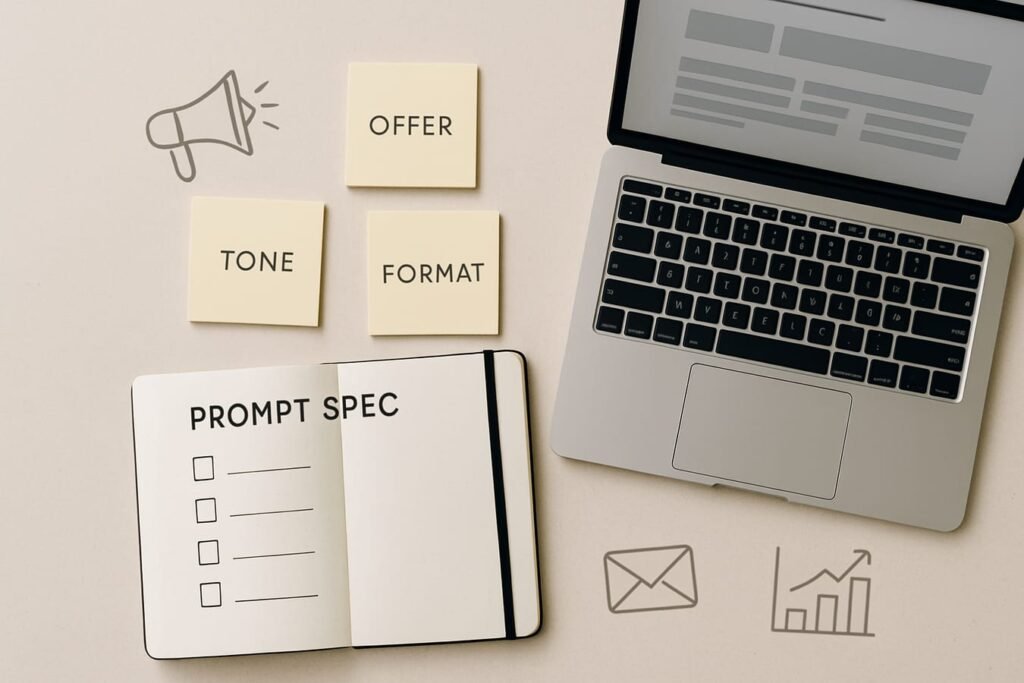
A simple “Prompt Spec” that works for most marketing tasks
If you want a reusable pattern, think like a creative brief—just smaller. The best prompts typically include:
- Objective: what success looks like (generate leads, increase trials, reduce churn, etc.)
- Audience: one primary segment, plus what they care about and what they doubt
- Offer: what you’re selling, price range (if relevant), and why it’s different
- Channel: email, landing page, LinkedIn post, Google ad, etc.
- Brand voice: traits, banned words, and examples
- Constraints: length, structure, reading level, claim boundaries, required keywords
- Output format: bullets, table, headings, variants, or a step-by-step plan
- Quality bar: what to optimize for (clarity over cleverness, specificity, benefit-proof pairs)
You can keep this as a short template and fill the blanks in 60–90 seconds. That’s usually enough to eliminate “generic AI copy.”
Mistake #1: Starting with the deliverable instead of the decision
“Write a landing page” is a deliverable. But marketing decisions come first: who it’s for, what action you want, and what the page must not do (overpromise, confuse, distract).
Fix: anchor the prompt to one conversion decision
Better prompt (landing page draft):
- Goal: Draft landing page copy that drives demo bookings for a B2B analytics tool.
- Audience: Operations managers at 50–500 employee ecommerce brands; worried about inventory accuracy and reporting delays.
- Offer: “14-day guided trial” (no credit card); key differentiator is real-time dashboards and automated anomaly alerts.
- Objections to handle: setup time, data security, and whether it integrates with existing tools.
- Format: Hero (headline + subhead + CTA), 3 benefit sections with proof points, short integrations section, FAQ (5 items), closing CTA.
- Constraints: No unverifiable claims like “guaranteed ROI.” Keep tone confident, plainspoken, not hype.
Notice what’s missing: fluff. Notice what’s present: decisions.
Mistake #2: Treating “tone” as a single switch
“Make it friendly and professional” doesn’t tell the model what to sound like. Brand voice is more like a set of constraints: words you use, words you avoid, rhythm, and how you handle certainty.
Fix: give a tiny voice guide (do/don’t) plus examples
Try pasting a compact voice spec into your prompts:
- Voice traits: practical, candid, slightly witty (never sarcastic)
- Do: use short sentences, concrete verbs, specific numbers when provided, and clear CTAs
- Don’t: use buzzwords (revolutionary, game-changing), excessive exclamation points, or vague promises
- Preferred phrases: “Here’s the trade-off,” “What this means in practice,” “If you only fix one thing…”
- Example lines to mimic: “You don’t need more content. You need fewer pieces that pull their weight.” / “Clarity beats cleverness when someone is about to spend money.”
This takes up a few lines, but it saves you rounds of rewrites.
Mistake #3: Asking for “ideas” without forcing variety
If you ask for “10 campaign ideas,” you’ll often get 10 variations of the same safe concept. The model isn’t being lazy; it’s optimizing for what it’s seen most often.
Fix: demand a spread of risk levels and angles
Use structure that makes sameness harder:
- 5 safe angles: straightforward benefit-led
- 5 bold angles: sharper positioning, stronger point of view
- 3 contrarian angles: challenge a common assumption (without being misleading)
- For each angle: the core message, a proof idea, and the best channel for it
You can also ask for a quick scoring pass: clarity, differentiation, and plausibility (1–5 each). That extra step improves the shortlist dramatically.
Mistake #4: Letting ChatGPT invent facts (or forgetting to set boundaries)
Business and marketing writing is full of landmines: compliance, pricing, guarantees, competitor claims, testimonials, and statistics. If your prompt doesn’t set rules, the model may fill gaps with confident-sounding details.
Fix: add “facts you can use” and “facts you must not invent”
In your prompt, include two short lists:
- Approved facts: pricing, key features, shipping/return policies, supported integrations, locations, certifications
- Do not invent: customer counts, revenue impact, “#1” rankings, clinical/financial guarantees, legal claims, competitor comparisons without sources
Then add one line: “If you need missing information, ask up to 5 clarifying questions before drafting.” This single instruction prevents a surprising amount of nonsense.
Mistake #5: Forgetting the channel constraints
Copy that looks fine in a doc can fail in the real world: too long for an ad, too dense for LinkedIn, too formal for SMS, or too vague for a landing page hero.
Fix: specify the channel, the hard limits, and the job of that asset
Examples of constraints worth stating:
- Google Search ads: headline and description character limits; include keyword once; avoid repetition
- LinkedIn post: strong first 2 lines; 120–220 words; one clear takeaway; one CTA
- Email: subject line options (35–55 chars), preview text options, scannable body, one primary CTA
- Landing page: benefit + proof pairings; visual sections; objections handled with specificity
If your team works across channels, it’s worth building a small library of channel “specs” you can paste into prompts.
Prompt examples you can copy (and edit fast)
These are intentionally practical. Replace the bracketed parts, keep the structure.
1) Positioning and messaging (clear, not fluffy)
- Task: Create positioning for [product] for [primary audience].
- Inputs: Differentiators: [list]. Competitors: [list]. Proof: [reviews, metrics you can verify].
- Constraints: No “best/leading” claims without evidence. Avoid buzzwords.
- Output:
- One-sentence positioning statement
- 3 key messages (each with a supporting proof point)
- 5 on-brand taglines (max 6 words)
- “What we’re not” section (3 bullets) to sharpen differentiation
2) Email sequence (salesy enough to work, not enough to annoy)
- Goal: Write a 4-email nurture sequence for [offer].
- Audience: [who], pain points [list], main objection [one sentence].
- Voice: [traits] + avoid [words].
- Structure: Email 1 = problem framing; Email 2 = proof and process; Email 3 = objection handling; Email 4 = clear CTA with gentle urgency.
- Output format: For each email: 3 subject lines + 2 preview texts + body (120–180 words) + single CTA.
3) Ad variations (volume with guardrails)
- Task: Generate 12 ad copy variations for [channel: Meta/LinkedIn/Google].
- Must include: [offer], [primary benefit], [one proof point].
- Must avoid: exaggerated promises, sensitive attributes, negative language about the user.
- Variation rules: 4 benefit-led, 4 proof-led, 4 objection-led. Each must use a different opening line.
- Output: Table with angle, primary text, headline, CTA suggestion.
Editorial callout: a quick checklist before you hit “send”
Prompt QA checklist (30 seconds):
- Is the objective measurable (even loosely)?
- Is there a single primary audience with a real pain and a real objection?
- Did you include the offer (and what makes it different)?
- Did you specify channel + format + length?
- Did you provide approved facts and list what must not be invented?
- Did you define brand voice with do/don’t and examples?
- Did you ask for options (variants) and a self-check?
How to iterate without drowning in rewrites
Many teams waste time by rewriting the whole prompt every round. A calmer workflow is to “lock” the brief and only adjust one variable at a time.
- Round 1 (brief + questions): Ask ChatGPT to restate the brief, list assumptions, and ask clarifying questions.
- Round 2 (first draft): Provide answers; request a draft in the exact format you need.
- Round 3 (variants): Ask for 5–10 variations with different angles, not just synonyms.
- Round 4 (tighten): Ask for a reduction pass (shorter, more specific), plus a compliance/claim check.
- Round 5 (handoff): Ask for a final version plus a change log: what it changed and why.
This is also where a broader learning hub helps; if you’re building a repeatable process, browse the AI for Marketing category for adjacent workflows and prompt patterns.
Common business use cases (and the prompting detail people miss)
Sales enablement
Missed detail: the stage of the deal. A “one-pager” for cold outreach reads differently than a one-pager for late-stage procurement. Put the stage in the prompt, along with what the buyer is trying to de-risk.
Content marketing
Missed detail: the reader’s starting knowledge and the internal point of view. Add “assume the reader knows X but not Y” and “our perspective is Z; we disagree with A.” That’s how you avoid generic articles.
Customer support and retention
Missed detail: what you’re allowed to promise. If refunds, timelines, or troubleshooting steps are regulated by policy, paste the policy excerpt (or a summary) and require the model to stick to it.
FAQ
How long should a business prompt be?
Long enough to remove ambiguity, short enough to scan. For most marketing tasks, a 10–15 line “mini-brief” beats a two-paragraph ramble. If it’s getting long, you’re probably mixing multiple tasks—split it into steps.
Should I assign ChatGPT a role (like “act as a CMO”)?
Sometimes. Roles help when you need a specific lens (performance marketer, brand strategist, email copywriter). But role prompts don’t replace real inputs. A role with no audience, offer, or constraints still produces generic output.
How do I get output that’s on-brand?
Give a compact voice guide (do/don’t) and a couple of example lines. Then ask for a “brand voice compliance check” at the end: words to replace, phrases that feel off, and the top 3 tone improvements.
Can I use ChatGPT output as-is for ads and claims?
Treat it as a draft. Marketing claims can create legal and platform risk if they’re exaggerated or unsubstantiated. Set boundaries in the prompt, and still review for accuracy, compliance, and fit with your actual policies and evidence.
What’s the single highest-impact improvement I can make?
Force specificity: one audience, one offer, one channel, one objective. Then add constraints (length/format) and a short “do not invent” list. That combination alone usually turns vague output into usable first drafts.
A practical next step: build a reusable prompt library
Instead of chasing the perfect prompt, save the versions that produced good output and label them by task: “Landing Page Hero,” “Email Nurture,” “Ad Variations,” “Positioning,” “Objection Handling,” “Edit for Clarity.” Over time, you’ll rely less on improvisation and more on proven specs—exactly how professional marketing teams work anyway.