AI can draft a landing page in minutes, spin ten ad variations on demand, and turn a webinar into a month of social posts. The tradeoff is familiar: the output starts to sound like everyone else—smooth, bland, and faintly interchangeable.
Keeping brand voice intact isn’t about “writing better prompts” in the abstract. It’s about treating voice like a product spec: documented, testable, and enforced through a workflow. Do that, and AI becomes a speed multiplier rather than a personality eraser.
Brand voice vs. tone (and why AI blurs the line)
Brand voice is the consistent personality behind your words—your default vocabulary, point of view, and rhythm. Tone is the emotional setting that changes with context (calm during an outage, celebratory during a launch).
AI tends to merge these into a single “pleasant marketing tone.” That’s why you’ll see the same symptoms across teams:
- Vocabulary drift: “seamless,” “robust,” and “game-changing” sneak in even if you’d never say them.
- Cadence mismatch: your brand is punchy, but AI outputs long, symmetrical paragraphs.
- Over-claiming: AI writes like it’s trying to win a pitch, not reflect your standards and substantiation.
- Channel mismatch: social captions read like blog intros; emails read like press releases.
The fix is to specify what must remain consistent (voice) and what is allowed to flex (tone), then bake both into prompts and review gates.
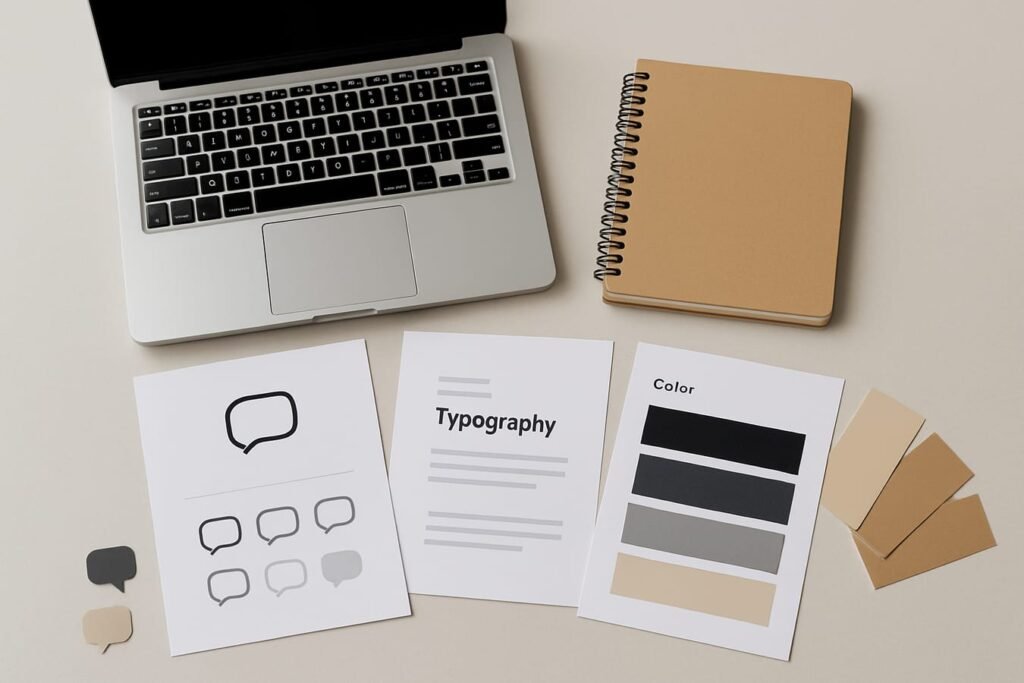
Start with a one-page brand voice “spec” (not a 40-page manifesto)
If your brand voice lives only in someone’s head—or in a slide deck no one opens—AI will fill the vacuum with generic defaults. Create a one-page reference that’s easy to paste into a prompt and easy for reviewers to enforce.
What to include in your one-page voice sheet
- Voice pillars (3–5): e.g., “Plainspoken,” “Optimistic but not hypey,” “Expert without jargon.”
- Audience reality: who they are, what they’re anxious about, what they already know.
- Signature language: phrases you use often (and why), plus words you avoid.
- Cadence rules: sentence length preferences, use of fragments, punctuation style.
- Claim boundaries: what you can say, what must be qualified, what requires a source or approval.
- Examples: 2–3 short “on-brand” snippets and 2–3 “off-brand” snippets with annotations.
Make “do/don’t” rules concrete
“Friendly” and “professional” are too fuzzy to enforce. Replace them with observable behaviors:
- Do: lead with the reader’s job-to-be-done; name the tradeoff; use short paragraphs.
- Don’t: stack superlatives; open with a generic industry statement; use filler like “unlock,” “elevate,” “transform.”
- Do: prefer specific verbs (“reduce review cycles,” “catch errors earlier”).
- Don’t: imply guaranteed results; avoid absolute language unless legally vetted.
The “brand voice block” you should paste into every AI request
Most teams prompt for what to write, not how to sound. Create a reusable block—your default instructions—then append channel and task details underneath.
A practical brand voice block (editable template)
- Role: You are a marketing writer for [Brand].
- Voice pillars: [3–5 bullets].
- Must-use language: [3–8 preferred words/phrases].
- Avoid: [banned words, hype phrases, clichés].
- Cadence: [short paragraphs, occasional fragments, minimal exclamation points, etc.].
- Claim rules: No guarantees; qualify performance claims; if unsure, write a cautious alternative.
- Output check: Before finalizing, verify the draft matches the voice pillars and contains none of the “avoid” list.
This isn’t about controlling every sentence. It’s about anchoring the model so its default style doesn’t override yours.
Channel-specific guardrails: the fastest way to stop “samey” content
Voice stays consistent, but each channel has its own constraints. If you don’t specify them, AI will reuse a blog-shaped pattern everywhere.
| Channel | What “on-brand” usually means here | AI pitfalls | Guardrails to add to the prompt |
|---|---|---|---|
| Homepage / landing page | Clarity first, benefits tied to proof, tight hierarchy | Vague value props, buzzwords, feature dumping | Limit to 1 primary claim per section; require a proof point; ban adjectives without evidence |
| Conversational, specific, one clear action | Press-release tone, long intros, multiple CTAs | Write at a “replyable” reading level; 1 CTA; subject lines without hype | |
| Paid ads | Direct, punchy, benefit-led, compliant | Overpromising, prohibited claims, sameness across variants | Create 10 variants with different angles; include compliance note; avoid absolute outcomes |
| Social | Human rhythm, distinctive point of view, scannable | Hashtag stuffing, generic “thought leadership,” long setup | Start with a concrete observation; keep to 1 idea; vary openings; avoid motivational clichés |
| Blog / SEO | Useful structure, examples, trustworthy boundaries | Fluff, redundant sections, unverified stats | Require examples and a checklist; note uncertainty; avoid invented numbers and sources |
Use AI for what it’s good at—then force the “human layer”
The easiest way to protect voice is to assign AI the tasks where voice matters less, and reserve voice-sensitive moves for humans (or for tightly constrained prompts).
High-leverage AI uses that don’t flatten your brand
- Structure: outlines, section options, alternative angles.
- Compression: turning a long draft into a tighter version while keeping key points.
- Variation: multiple headlines that keep the same promise.
- Repurposing: webinar → blog skeleton → social post list (with review).
- First-pass editing: flagging unclear sentences, redundancies, and missing context.
Tasks that need extra guardrails (or a human lead)
- Brand positioning language: taglines, category definitions, “big idea” copy.
- Claims and comparisons: anything that could be construed as a promise or a legal statement.
- Customer stories: details must be factual and approved; avoid “invented” anecdotes.
- Delicate moments: crisis comms, layoffs, outages, sensitive social issues.
Editorial callout: Treat AI as a junior writer with turbo speed. You wouldn’t let a new hire publish without a style guide, examples, and a review pass. Use the same standard with AI—fast drafts, clear guardrails, and real editing.
Three practical prompting patterns that keep voice intact
You don’t need clever tricks; you need repeatable patterns. Here are three that work across most industries.
1) “Write like us” by showing, not telling
Instead of describing your voice with adjectives, provide a short sample paragraph (100–200 words) that’s undeniably on-brand, then ask the model to match its rhythm and vocabulary. Add a second sample that’s off-brand and explain why.
- On-brand sample: a recent email or post that performed well and matches current positioning.
- Off-brand sample: a generic competitor-style paragraph; label the issues (hype, vague, too formal).
2) “Draft, then self-critique against the voice sheet”
Ask for two outputs: the draft and a brief checklist-style critique that references your voice pillars and banned words. This forces the model to “look back” before you ever see the copy.
- Draft content.
- Voice audit: 5 bullets (what matches, what risks drifting).
- Revision: produce the improved version.
3) “Create options by strategy, not synonyms”
Most AI variations are superficial: swapped adjectives and recycled structure. Instead, request variants based on distinct messaging angles:
- Angle A: time saved
- Angle B: fewer mistakes / higher confidence
- Angle C: better collaboration
- Angle D: cost control (careful with promises)
When each option has a different strategic frame, your brand voice has room to show up rather than getting diluted by near-duplicates.
A simple workflow: draft fast, review smart, publish confidently
Brand voice breaks when AI is used ad hoc. A lightweight workflow keeps output consistent without adding a bureaucracy tax.
Suggested AI-to-publish flow (works for small teams)
- Brief (human): define audience, objective, single main point, and required proof.
- Draft (AI): use the brand voice block + channel guardrails.
- Voice pass (AI + human): run the voice audit; then a human makes voice-defining edits.
- Fact/claim check (human): verify stats, product details, comparisons, and any “results” language.
- Final polish (human): remove clichés, tighten openings, add specifics and examples.
- Library update (team): save the prompt + what worked so next time is easier.
If your team wants more ready-to-use patterns, build your library from a curated set of Marketing Prompts and then customize each prompt with your voice sheet.
The on-brand AI checklist (printable, shareable)
- Voice pillars present: I can point to specific lines that demonstrate each pillar.
- No banned language: none of our avoided phrases or empty superlatives made it through.
- Concrete over abstract: at least 3 specifics (numbers, steps, examples, constraints, proof points).
- One primary promise: the reader can repeat the main value in one sentence.
- Claims are defensible: performance language is qualified; comparisons are fair; no invented stats.
- Channel fit: length, CTA count, formatting, and reading rhythm match the platform.
- Human fingerprints: a strong opening, distinctive phrasing, and a point of view—not just “well-written.”
Common failure modes (and how to correct them quickly)
“It sounds polished… but not like us.”
Correction: add a real on-brand sample and require the model to mimic cadence (sentence length, paragraphing) and lexicon (preferred words). Then do a human line edit on the first 15%—openings set the voice for everything that follows.
“The content is accurate, but it feels cold.”
Correction: add a “reader reality” constraint: what the reader is worried about and what they’re trying to do this week. Ask for one empathetic line, not a soft intro.
“It’s too hypey and makes risky claims.”
Correction: include claim boundaries in the brand voice block. Require alternatives: “If a claim is not provable from the provided notes, replace it with a cautious, truthful version.”
“Every channel now sounds like the blog.”
Correction: write channel templates once (email, paid, social, landing page) and reuse them. AI behaves better with a familiar mold than with a blank page.
FAQ
Will AI inevitably make our content sound generic?
No, but generic output is the default when the model has weak constraints. A one-page voice sheet, a reusable voice block, and a consistent review step usually eliminate most “same voice” problems.
Should we train a custom model to preserve brand voice?
Sometimes, but it’s rarely step one. Many teams get 80% of the benefit by standardizing prompts, adding examples, and enforcing a workflow. Customization can help if you produce high volume, have stable messaging, and can maintain training data responsibly.
How do we keep multiple writers (and multiple AI users) consistent?
Create a single source of truth: one voice sheet, one banned-words list, and a shared prompt library. Use a lightweight approval path for “voice-defining” assets (homepage, positioning pages, flagship campaigns) so changes don’t fragment across the organization.
What’s the best way to measure whether brand voice is slipping?
Use simple periodic audits: sample 10 pieces across channels each month and score them against your voice pillars and claim rules. Track the most common edits (e.g., removing buzzwords, tightening openings) and turn those into prompt guardrails.
Can AI help us develop a brand voice guide in the first place?
Yes—with supervision. AI can summarize patterns from your best-performing copy, propose draft pillars, and generate do/don’t examples. A human still needs to make the final calls, especially around positioning, sensitive topics, and claims.
Next step: build a voice system you can reuse
Set aside one hour to draft your one-page voice sheet, pick three on-brand samples, and assemble a default “brand voice block.” Run a small pilot: one email, one social post, one landing section. If the review checklist catches the same issues twice, you’ve found your next rule to codify.